
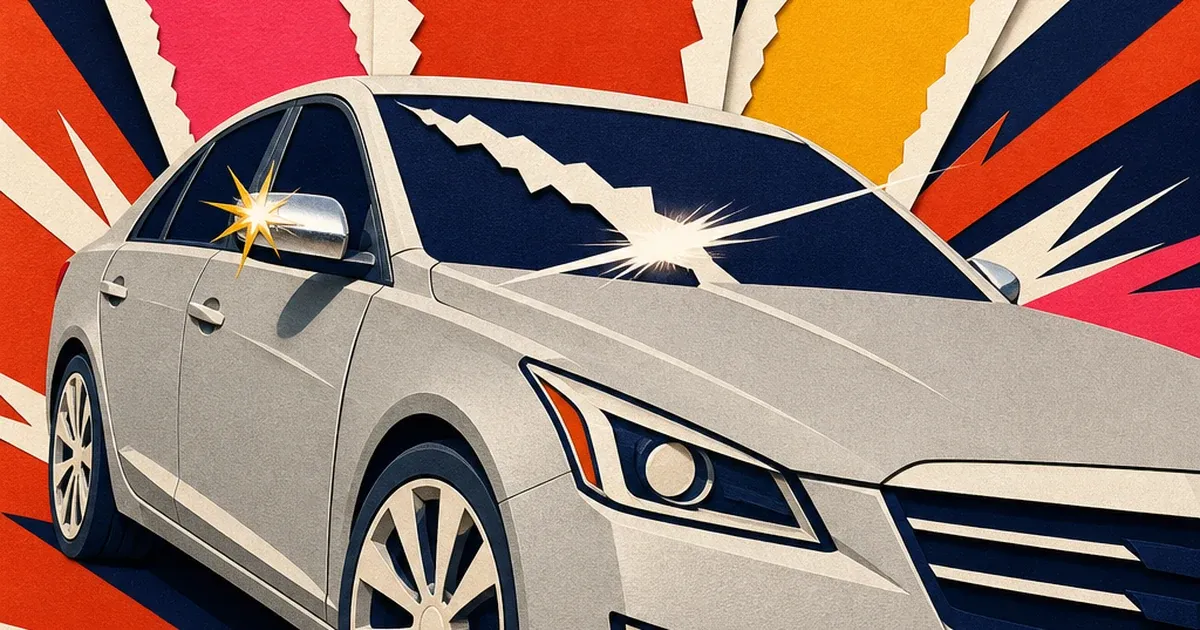
A dealership photo lot at noon is a wall of reflective surfaces. Glass, chrome, a polished hood, all of it bouncing sunlight straight back into the lens. The result is a listing photo with a hot glare streak across the windshield, a mirrored dashboard ghosting through the glass, or a chrome trim piece blown out to pure white. None of that is a bad photographer's fault. It is what happens when the most reflective object on the lot has to be shot outdoors, fast, between test drives, with whatever light is available that hour.
That photo, glare and all, is usually what goes straight into the ad account. Whatever flaw it carries gets repeated across every platform and size the campaign needs: a Facebook square, an Instagram Story, a Google Display banner, all built from the same flawed source instead of a fixed one.
The photo does the selling before the salesperson gets the chance
Car buyers browse online long before they walk onto a lot, and the photo is what decides whether they click through or keep scrolling. A Redline survey of 372 recent vehicle shoppers found that 87% would click a clear, well-lit, well-framed photo over a blurry or poorly lit one, and 95% said professional-looking photos meaningfully increase how much they trust a vehicle's perceived value (Redline, via Auto Remarketing, "Survey finds consumers more likely to click on vehicles with high-quality photos," 2024).
Cox Automotive's own dealer research backs this with a harder number: swapping a stock photo for multiple custom photos increased click-through to new-car vehicle detail pages by 133%, and to used and certified pre-owned pages by 349% (Cox Automotive, "Telling Your Value Story Through Photos"). That gap is not about having more photos of the same flawed shot. It is about the shot itself being clean enough to hold attention past the first glance.
A separate, independent line of research backs the same pattern outside the auto industry specifically. Cornell Tech researchers built an image-quality model and tested it against real eBay and Letgo marketplace listings, finding that higher-quality product photos sold 1.17 to 1.25 times more often than lower-quality ones for the same item (Cornell Chronicle, "Is seeing believing? Depends on photo quality, study says," 2019). A glare streak or a distracting reflection is exactly the kind of flaw that model would score down.
Why a car photo breaks the rules that work for everything else
Most advice about clean product photography assumes a matte surface, the kind covered in how to change a product's background for a Facebook ad. Apparel sits flat under diffused light. A skincare bottle has one small reflective cap, not an entire reflective body. A vehicle is a different problem: nearly every visible surface, glass, chrome, painted metal in direct sun, throws back a reflection, and a dealership rarely has the studio setup (polarizing filters, controlled lighting rigs, a covered bay) to shoot around it every time inventory turns over.
That means the flaw is baked into the source photo on a predictable cadence. New inventory arrives, it gets photographed on the lot in whatever light is available, and the photo goes straight into whatever ad or listing tool the dealership uses next. Fixing the reflection after the fact, once, is far faster than reshooting every unit under controlled conditions.
Fix the photo before you multiply it
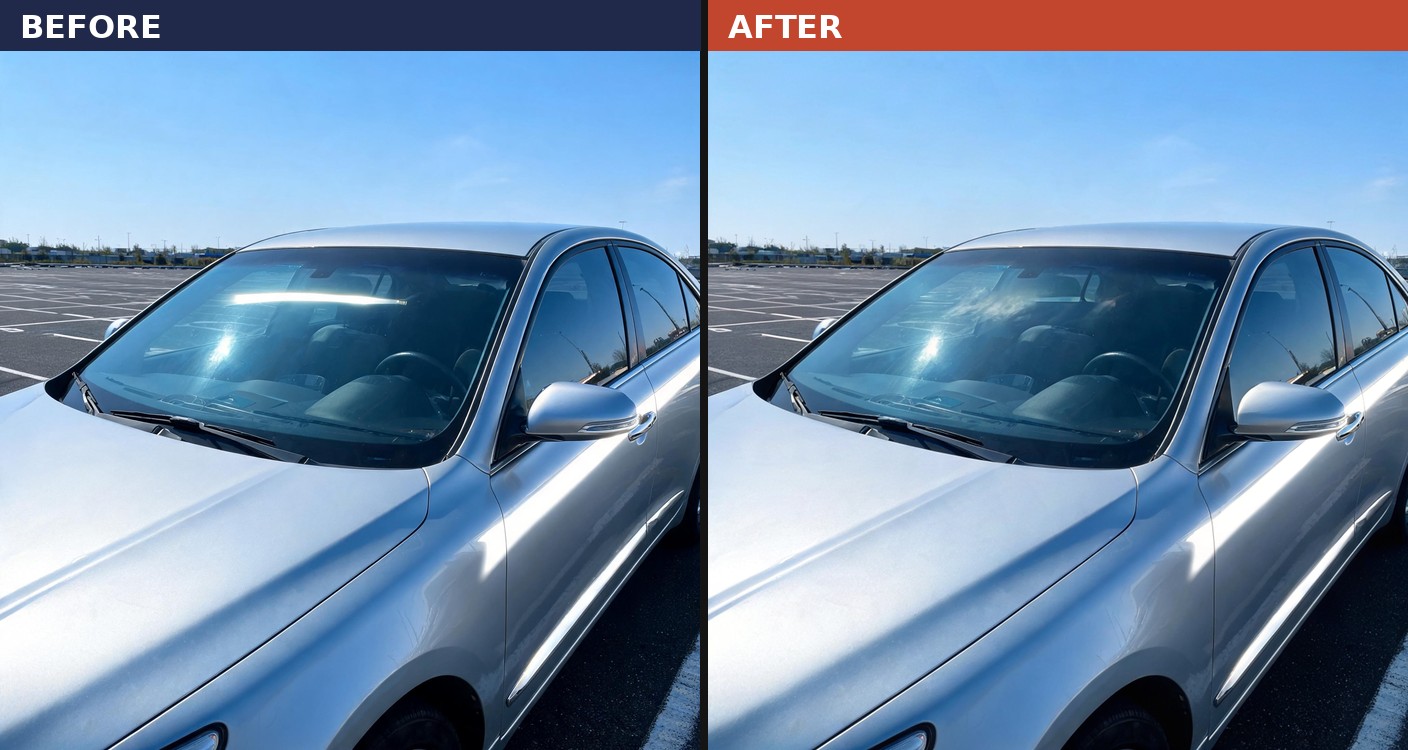
Ad Studio's repair layer, enhance_asset_proxy, exists for exactly this step. One tool covers the full set of repair operations, upscaling, sharpening, denoising, lighting and white-balance correction, background swaps, object removal, chosen through a single model field that pairs the specific fix to the specific flaw. For a windshield glare or a chrome reflection washing out part of the frame, the relevant op is a lighting and exposure correction: pass the source imageUrl, preview the token cost, and let the correction pull the blown-out highlight back into a readable range without touching the vehicle itself.
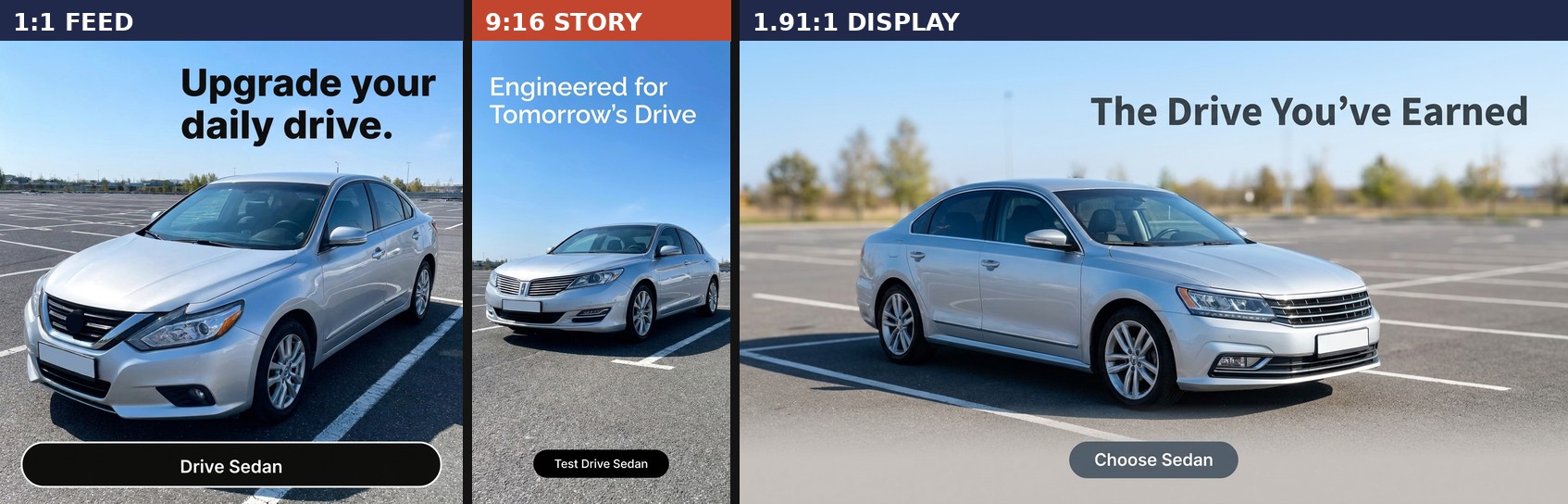
Once the source photo is clean, the fan-out step is generate_image_templates, Ad Studio's primary image-ad generator. One corrected vehicle shot becomes a square Facebook post, a 9:16 Story, and a horizontal Display banner in one pass, all sized to the exact spec each placement expects, without a second shoot on the lot and without re-fixing the same glare on five different files.
Building this into a dealership's actual inventory turnover
This is the exact repair-then-generate order the automotive vertical on Coinis is built around: fix the flaw once, then let every ad format and market inherit the clean source.
Inventory turns over constantly, which means this cannot be a one-time fix. The order matters every time a new unit gets photographed: repair the photo first with enhance_asset_proxy (glare, reflection, exposure), and only then hand the clean file to generate_image_templates for the size fan-out or to the cinematic product-shot preset for a showroom-style hero angle. Doing it in the other order just resizes or restyles a photo that still has the glare baked in, producing five flawed variants instead of one clean set.
This is also the same creative-fatigue problem documented in mobile game ad creative fatigue: a dealership that only has one usable shot per vehicle, glare-free and legible, tends to run that single shot until performance drops, because there is no second angle or format to rotate in. A corrected photo that can survive a background swap, a showroom preset, and a full ad-size fan-out gives a dealership the same variety lever without a second visit to the lot. And once a corrected shot exists, localizing it for a second-language market is a resize-and-translate step, not a reshoot, for dealerships advertising to bilingual buyer bases.
FAQ
Does enhance_asset_proxy change the vehicle itself, the paint color, the trim? No. It repairs the existing photo (lighting, exposure, glare, reflections) without altering the product. Paint color, trim, and badge details stay exactly as photographed. What changes is what is distracting or damaging around them.
Can I fix windshield glare without losing the sense that the photo was shot on a real lot? Yes. The fix targets legibility and exposure balance, not the presence of natural light. A vehicle still reads as shot outdoors under real light. What gets corrected is a highlight blown out enough to hide the interior or a reflection dense enough to obscure the windshield or dashboard.
Do I need a different photo for every ad platform, or does one corrected shot cover all sizes? One corrected shot covers all sizes. generate_image_templates handles the resizing and cropping into each platform's spec from that single clean source, which is the entire point of fixing the photo once instead of five times.
What if the original photo is also dark or grainy, not just glare? The same enhance_asset_proxy tool handles denoising and lighting or exposure correction as separate ops within the same surface, so a dim or grainy lot photo goes through the same repair-then-generate chain, just with a different model selection for the specific flaw.
The Coinis angle
A dealership does not need a reshoot every time inventory turns over or a size changes. Repair the one photo already on file with Ad Studio's enhance_asset_proxy, then turn it into a full ad-ready set with generate_image_templates, and land the whole thing as a launch-ready ad through Ad Studio's templates instead of exporting raw images and building the ad by hand.
Sources
- Redline, via Auto Remarketing, "Survey finds consumers more likely to click on vehicles with high-quality photos," May 23, 2024. https://www.autoremarketing.com/ar/analysis/survey-finds-consumers-more-likely-to-click-on-vehicles-with-high-quality-photos/
- Cox Automotive, "Telling Your Value Story Through Photos." https://www.coxautoinc.com/insights-hub/telling-your-value-story-through-photos/
- Cornell Chronicle, "Is seeing believing? Depends on photo quality, study says," January 2019 (study: Xiao Ma et al., "Understanding Image Quality and Trust in Peer-to-Peer Marketplaces," WACV 2019). https://news.cornell.edu/stories/2019/01/seeing-believing-depends-photo-quality-study-says

Isidora Matovic
Author
Social media enthusiast and a full time researcher. She takes digital presence very seriously and that is why you are always in touch in what is going on with us! Follow us for more posts like this.